Picasso Robotic DHI: Dr. Terziler’s Artistic Robotic Hair Transplant
Dr. Terziler's flagship: his own robotic system plus his own hand-drawn hairline artistry for the most natural, high-density result. Surgeon-led at every step.
Learn More
Hair transplant in Turkey works best with doctor-led care, personalized donor assessment and natural hairline design. Founded by Dr. Terziler, developer of the clinic’s robotic hair transplant system, our AACI-accredited clinic in Istanbul offers DHI, Robotic DHI and Picasso Robotic DHI. Each treatment plan considers your hair loss pattern, donor capacity and long-term goals. Our internal audit of 120 Picasso Robotic DHI cases recorded 98.1% graft survival at 12 months. Explore real before-and-after results, meet our medical team and request a free personalized assessment, with documented follow-up after you return home.
Dr. Terziler's flagship: his own robotic system plus his own hand-drawn hairline artistry for the most natural, high-density result. Surgeon-led at every step.
Learn More
Doctor-led robotic DHI with ±0.1 mm depth, angle and density control: up to 97.3% graft survival, minimal shaving.
Learn More
Choi-pen implantation for hairline and crown precision: up to 97.3% survival, 50–60 FU/cm² density, optional no-shave. From €3,400.
Learn More
Keep your current hairstyle: discreet DHI with no visible shave and fast social return. From €3,500.
Learn More
Curved-follicle expertise for Afro and textured hair, adapted extraction that protects your donor.
Learn More
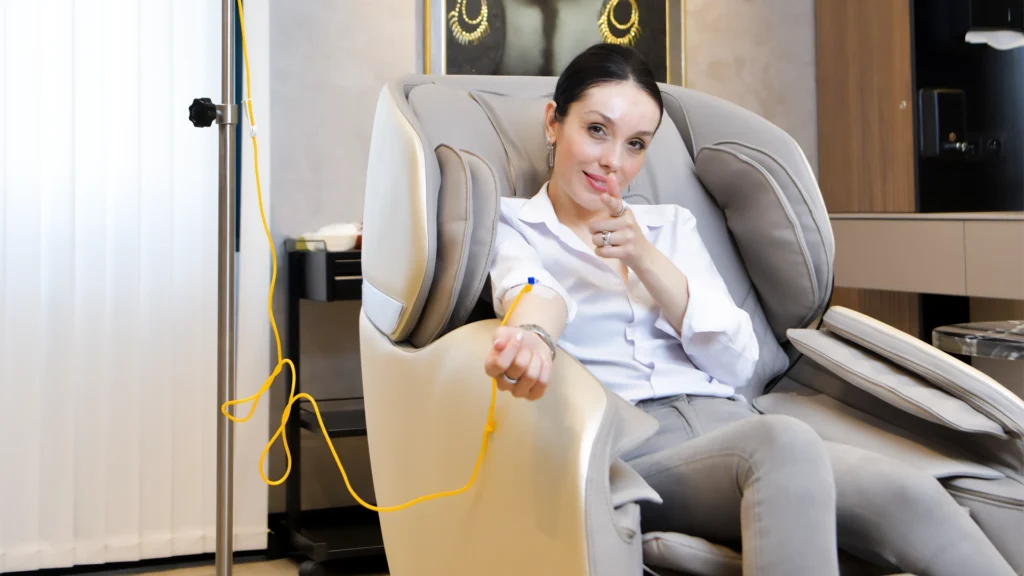
No-shave, hairline-preserving DHI planned for women's density and part-line thinning; surgeon-led.
Learn More
Build a fuller, natural beard line with precise angle and direction control: facial-hair DHI planned graft by graft.
Learn More
Single-hair, directional artistry for natural brows that grow for life; small graft count, high precision.
Learn More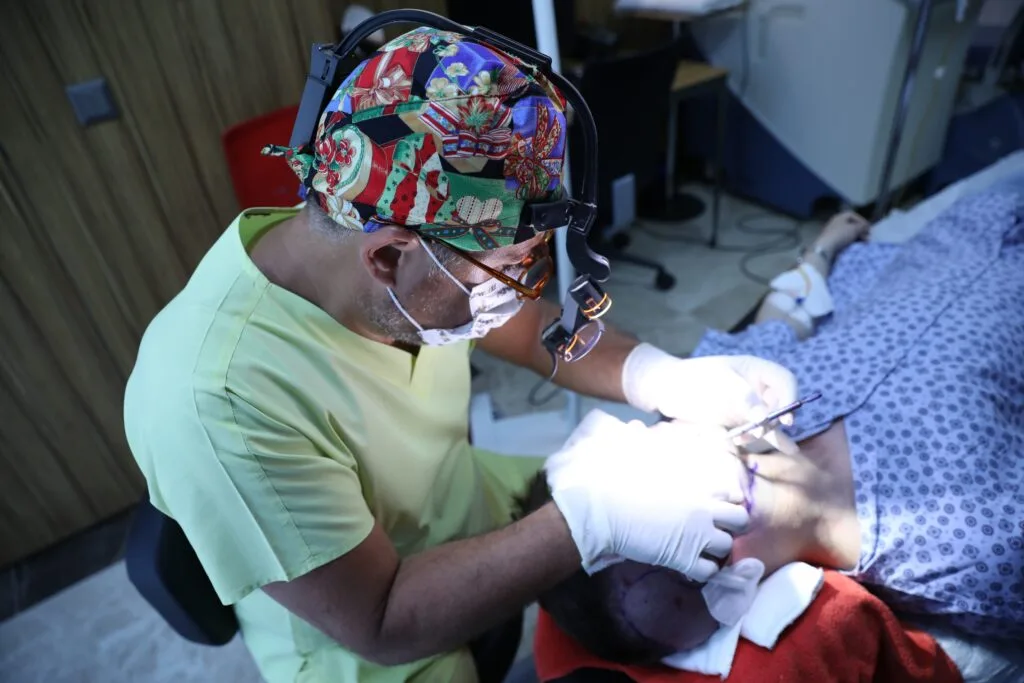
Restore a dense, even moustache with fine single-hair placement: natural growth direction, discreet and permanent.
Learn More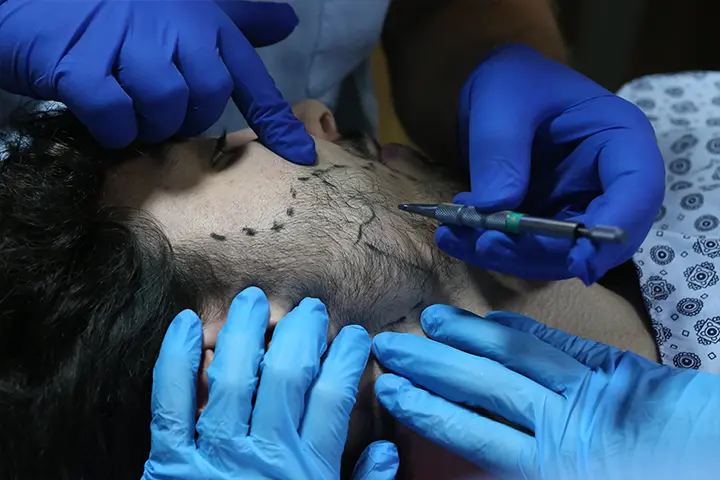
Reshape and thicken sideburns to frame your face; symmetry-focused DHI that blends seamlessly with existing hair.
Learn More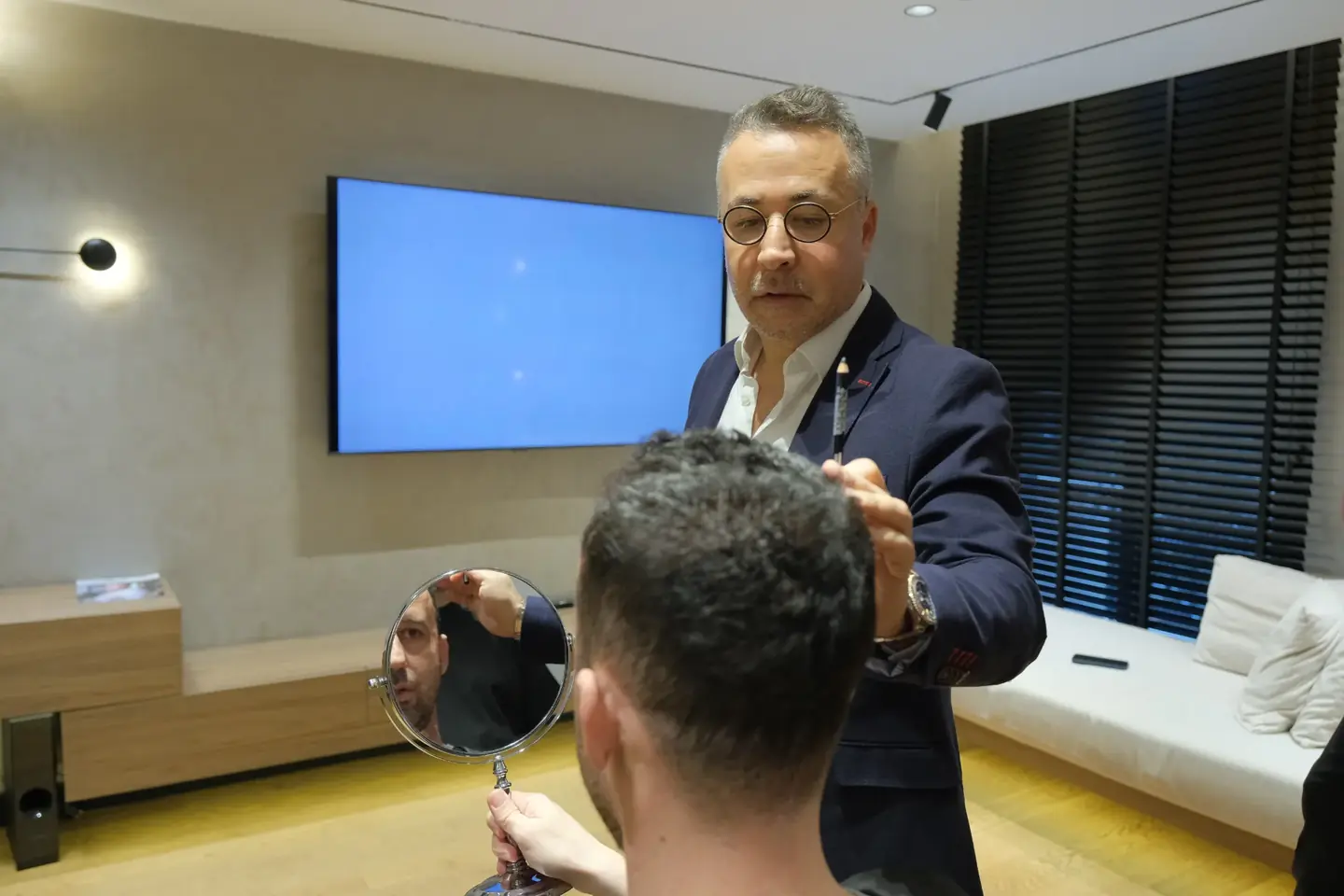
| TL;DR | Answer |
|---|---|
| What is a hair transplant in Turkey? | It is a same-day surgical procedure where donor follicles are moved to thinning areas under local anaesthesia after donor mapping and hairline planning. |
| What is the cost of a hair transplant in Turkey in 2026 | Packages at Dr. Terziler start from €4,500 in 2026. This is the entry DHI package price; Robotic DHI and Picasso Robotic DHI are priced higher and quoted after assessment. The broader €3,200–€10,000 Turkey-market reference is not the clinic’s price list. Request a written, itemised quotation. |
| What is the best technique? | The best technique depends on donor density, hair calibre, hairline goals, and shaving preference. Picasso Robotic DHI is Dr. Terziler Clinic’s premium doctor-led protocol for precise angle and density planning. |
| How safe is the procedure? | Safety depends on accreditation, doctor involvement, donor-zone limits, sterile technique, and follow-up. ISHRS warns patients to avoid unlicensed personnel and false advertising claims. |
| How do I start? | Request an initial assessment on WhatsApp or through the contact form. Suitability and a final surgical plan require medical assessment. |
Watch the clinic’s video about former soccer player Anton Trifonov’s hair transplant. Use patient stories alongside your own medical assessment, proposed graft plan and documented follow-up.
| Clinic | Dr. Terziler Exclusive Clinic, Istanbul, Turkey |
|---|---|
| Lead physician | Dr. Servet Terziler. Cases are assigned to a named physician; Dr. Kürşat Yalvaç may lead the medical plan and follow-up when assigned to the confirmed treatment schedule. Independent certificate/name search: Dr. Servet Terziler’s official profile. |
| Accreditation & credentials | AACI International Accreditation, current through . The clinic also holds Turkey’s International Health Tourism Authorization and is officially registered with HealthTürkiye. These credentials relate to facility accreditation, international-patient authorization and official health-tourism registration respectively. Additional directory: AACI certificates archive. |
| Procedure model & physician involvement | Doctor-led in each critical medical step. Dr. Servet Terziler and Dr. Kürşat Yalvaç personally perform recipient-site/channel creation for the cases assigned to them, according to the confirmed treatment protocol. The responsible physician is also involved in patient assessment, donor planning, individualized hairline design, density planning, complication management and follow-up. Technicians may assist with preparation and graft handling under supervision, but the clinic does not operate as a technician-led model. This aligns with the ISHRS warning that substantial medical aspects of hair restoration surgery should not be delegated to unlicensed personnel: ISHRS consumer alert. |
| Anaesthesia & sedation | Dr. Semra Uludemir, Anaesthesiologist, provides anaesthesia and sedation support when clinically indicated. Local anaesthesia and sedation planning are managed within the clinic’s medical protocol, with physician oversight based on the patient’s treatment plan and medical assessment. |
| Daily patient volume | Dr. Terziler Exclusive Clinic follows a boutique, limited-volume model and treats a maximum of four hair-transplant patients per day. Daily scheduling is structured to preserve named-physician involvement, individualized treatment planning and clinical oversight. |
| Technique focus | Robotic DHI, DHI, Sapphire FUE, Picasso Robotic DHI, donor-safe extraction planning, and natural hairline design. FUE and graft-handling context: FUE clinical overview. |
| Outcome data | DHI and broader Robotic DHI are reported at 90–97% graft survival. Picasso Robotic DHI internal outcome data records 98.1% graft survival at 12 months (n=120, clinic-reported). These are clinic outcome datasets, not peer-reviewed publications; they are interpreted alongside peer-reviewed evidence on graft storage and handling, long-term follicle survival, and complication prevention. |
| Safety transparency | Donor planning before graft count, safe extraction limits, age-appropriate hairline design, written aftercare, documented follow-up, 12-month photo review, and complication escalation pathway. Patient safety context: NHS hair transplant guidance and AAD hair-loss evaluation guidance. |
| What patients should still ask | Written surgeon-name confirmation, graft count rationale, donor-capacity calculation, methodology details, who performs each step, what is delegated to assistants, and what the written guarantee covers. |
Use this profile to check the clinic’s credentials and to prepare questions for your consultation. Accreditation, patient reviews and clinic-reported outcome data each answer different questions; none replaces an individual medical assessment.
Medical evidence used near claims: ISHRS technician-led/unlicensed personnel warning, Complications in Hair Transplantation, FUE clinical overview, graft storage media study, long-term follicle survival.
Use this clinic profile to compare physician involvement, current accreditation, donor planning, documented results and follow-up when choosing a hair transplant clinic in Turkey.
A patient comparing hair transplant options usually wants three things at once: a natural result, a safe medical pathway, and a price that makes sense. Turkey is competitive because Istanbul combines specialist hair-restoration volume, lower operating costs than the UK or US, and a mature all-inclusive medical tourism model. The important distinction is quality control: ISHRS warns that unlicensed personnel and false advertising remain a real risk in the global hair transplant market, so patients should choose by accreditation, named-surgeon responsibility, documented graft planning, and follow-up evidence.
Ask who will perform each surgical step, how the physician plans the donor area, and what follow-up photographs are available for patients with a similar pattern of hair loss.
Local costs and package structure can make treatment more affordable. Compare written quotations with the same graft plan, named surgeon and follow-up inclusions rather than assuming that every low price offers equivalent care.
AACI lists Dr. Terziler Exclusive Hair Clinic as an accredited outpatient specialist centre. Check the public registry and confirm the current licence and medical team before booking.
The clinic’s packages can combine the procedure, hotel, transfers, care kit and follow-up. Confirm the exact inclusions, number of hotel nights and travel dates in writing.
A natural hairline needs to suit your face today and allow for future hair loss. Ask for comparable cases at stated follow-up months and a plan that protects remaining donor capacity.
Dr. Terziler Exclusive Clinic offers physician-led planning in Istanbul. Its AACI listing and the lead physician’s profile provide starting points for checking credentials. Confirm your own treating doctor and surgical responsibilities in writing.
Hair transplant surgery usually uses follicular unit extraction (FUE) or follicular unit transplantation (FUT) to obtain donor grafts. DHI describes placement using an implanter pen after extraction. FUE leaves small punctate scars; FUT leaves a linear donor scar. Careful donor management and implantation help the result blend with existing hair.
The process starts with a detailed consultation, scalp analysis, and donor assessment. The surgeon checks donor density, hair calibre, hairline shape, and the size of the thinning area. After that, the team calculates the graft count and the surgeons design a hairline that fits the patient’s age, facial proportions, and future hair-loss pattern. Local anaesthesia is then applied so the procedure can be performed with minimal pain.
Local anaesthesia is used during treatment. After donor graft collection, the physician places grafts into recipient sites or uses an implanter pen. Both methods depend on careful handling, placement and medical judgment.
Hair transplant surgery in Turkey at Dr. Terziler Clinic usually takes 6 to 8 hours, depending on the number of grafts. After the procedure, patients can return to their hotel on the same day.
A 2,500–3,000 graft plan does not determine a fixed Dr. Terziler price. The clinic’s DHI starting package is €4,500; the final quote follows donor assessment, technique selection and written package confirmation. Picasso Robotic DHI, Dr. Terziler’s proprietary premium protocol, is priced higher because it is designed around doctor-led planning, angle mapping, and controlled graft handling. Final pricing should always follow donor assessment, not a generic online graft promise.
→ Full hair transplant Turkey cost guide, package comparison and 2026 budget planning
| Technique | Clinic pricing | Graft Survival | Key Feature |
|---|---|---|---|
| FUE (Sapphire) | Individual quote after assessment | No separate audited rate published | Sapphire blade, minimal scarring |
| DHI | From €4,500 — entry DHI package | 90–97% (clinic-reported) | Channel-free Choi pen, no pre-made channels |
| Robotic DHI | Above entry DHI; individual quote | 90–97% (clinic-reported) | AI-assisted extraction + Choi pen implantation |
| Picasso Robotic DHI | Above entry DHI; individual quote | 98.1% (12-month internal audit, n=120; clinic-reported) | Picasso protocol; precise implanter placement and individual density planning |
| FUT (Strip) | Confirm suitability and availability | No separate audited rate published | Linear scar, high graft yield per session |
| Unshaven DHI | Individual quote after assessment | No separate audited rate published | Reduced shaving where suitable; individual surgical plan |
| Female Hair Transplant | Individual quote after assessment | No separate audited rate published | DHI / Unshaven DHI, Ludwig scale I–III |
| Afro / Curly Hair | Individual quote after assessment | No separate audited rate published | Modified 1.0–1.2mm punch, adapted angle protocol |
| Beard (Partial) | Individual quote after assessment | No separate audited rate published | 1,000–2,000 grafts, occipital donor only |
| Full Beard | Individual quote after assessment | No separate audited rate published | 1,500–3,000 grafts, DHI protocol |
| Moustache | Individual quote after assessment | No separate audited rate published | 100–500 grafts per area, 10–20° angle |
| Eyebrow | Individual quote after assessment | No separate audited rate published | 150–400 grafts/brow, 15–20° precision |
| Sideburn / Facial | Individual quote after assessment | No separate audited rate published | 200–600 grafts per side |
| BHT Add-On | Quoted separately if suitable | No separate audited rate published | Body hair supplement for NW6–7 |
| Hairline Top-Up | Individual quote after assessment | No separate audited rate published | Density reinforcement session |
Dr. Terziler does not use a fixed per-graft pricing system. Packages start from €4,500 for DHI; Robotic DHI and Picasso Robotic DHI are priced higher and quoted individually. Graft count helps the team assess donor capacity and coverage, but it does not generate a fixed clinic tariff. Compare the complete written quote and inclusions.
| Technique | Pricing approach | Clinic quote | Notes |
|---|---|---|---|
| Sapphire FUE | No fixed per-graft tariff | After assessment | Assess coverage and donor capacity for larger plans |
| DHI | No fixed per-graft tariff | DHI packages from €4,500 | 90–97% graft survival |
| Unshaven DHI | No fixed per-graft tariff | After assessment | Premium for no-shave privacy option |
| Picasso Robotic DHI | No fixed per-graft tariff | Premium quote after assessment | 98.1% graft survival (12-month internal audit, n=120; clinic-reported) + up to 52 FU/cm² in selected cases |
A 2,000-graft hair transplant at Dr. Terziler is quoted after assessment, not priced from a fixed graft-count tariff. Clinic packages start from €4,500 for DHI; Robotic DHI and Picasso Robotic DHI are priced higher. Limited frontal or temple restoration may be considered where donor planning allows it. Technique, graft count and package inclusions are confirmed individually.
A 3,000-graft hair transplant at Dr. Terziler requires an individual quote. The clinic’s DHI packages start from €4,500, but 3,000 grafts do not determine a fixed package price. Frontal coverage, donor capacity, technique and the long-term plan are assessed before the written quote is confirmed.
A 4,000-graft hair transplant at Dr. Terziler is quoted individually after donor assessment. The clinic’s general DHI starting price is €4,500, not a fixed price for a 4,000-graft case. Larger plans require confirmation of donor capacity, technique, operative staging and package scope.
A 5,000-graft hair transplant at Dr. Terziler has no fixed published graft-count price. DHI packages start from €4,500; this is not a quote for every 5,000-graft case. FotoFinder donor mapping, the hair-loss pattern and safe available donor supply determine whether a larger or staged plan is suitable and what it costs.
The clinic’s published information states that in-clinic financing is not currently offered. Ask the patient coordination team for the deposit, payment schedule, cancellation terms and accepted payment methods in writing. If you arrange finance independently, confirm directly with the provider whether overseas treatment is covered.
Prices depend on the individual clinic, graft plan and package. The country figures below are illustrative budgets used for planning, not independently verified national averages. Compare current written quotes, travel costs and follow-up arrangements before choosing a provider.
| Country | Illustrative treatment budget |
|---|---|
| Turkey (Istanbul) | €3,200–€10,000 market reference; Dr. Terziler packages from €4,500 |
| United Kingdom | £8,000–£14,000 |
| USA | $12,000–$20,000 |
| Germany | €8,000–€12,000 |
| Spain | €5,000–€9,000 |
| Poland | €3,500–€5,500 |
| UAE (Dubai) | $6,000–$10,000 |
| India | €1,200–€2,500 |
| Thailand | €2,500–€4,500 |
| Mexico | $3,500–$6,000 |
| Hungary | €3,000–€5,500 |
| South Korea | $6,000–$10,000 |
| Australia | AUD $15,000–$25,000 |
| Travel cost | What to confirm |
|---|---|
| Procedure | Written clinic quote for your graft count and technique. |
| Flights | Live return fare for your route, dates, luggage and flexible ticket terms. |
| Hotel | Property, room type, included nights and any extra-night charge. |
| Transfers and aftercare | Included journeys, wash appointment, follow-up and complication support. |
Compare a written quotation from your preferred UK clinic with the complete Istanbul journey: procedure, return flights, extra nights and follow-up. The medical comparison should focus on surgeon responsibilities, donor planning and documented outcomes. A country or an accreditation badge alone cannot guarantee a better result.
Compare a written quotation from your preferred USA clinic with the complete Istanbul journey: procedure, return flights, extra nights and follow-up. The medical comparison should focus on surgeon responsibilities, donor planning and documented outcomes. A country or an accreditation badge alone cannot guarantee a better result.
Compare a written quotation from your preferred Mexico clinic with the complete Istanbul journey: procedure, return flights, extra nights and follow-up. The medical comparison should focus on surgeon responsibilities, donor planning and documented outcomes. A country or an accreditation badge alone cannot guarantee a better result.
Compare a written quotation from your preferred India clinic with the complete Istanbul journey: procedure, return flights, extra nights and follow-up. The medical comparison should focus on surgeon responsibilities, donor planning and documented outcomes. A country or an accreditation badge alone cannot guarantee a better result.
A hair transplant Turkey all-inclusive package at Dr. Terziler Clinic covers every logistical and clinical element of the international patient journey at a single fixed price. No surprise itemisation on the day.
| Package Element | Dr. Terziler Clinic |
|---|---|
| Procedure (surgeon-led) | Named physician confirmed in your treatment schedule |
| Anaesthesia (vibrating device) | ✓ Included (vibrating protocol) |
| Partner hotel | Property, star category and included nights confirmed in your written quote |
| VIP Airport Transfer | ✓ Dedicated vehicle, not shared |
| Pre-Op FotoFinder Trichoscope | ✓ Included (all cases) |
| Post-Op Care Kit | ✓ Saline spray, shampoo, foam, lotion |
| Day 3 First-Wash Appointment | ✓ Included at clinic |
| Written guarantee / repair policy | Request the current duration, eligibility, exclusions and travel-cost terms |
| 12-Month Video Follow-Up | ✓ Included |
| Personal WhatsApp Coordinator | Personal coordinator; confirm contact hours and urgent-care route |
| Airport Security Medical Note | ✓ Provided before departure |
Request an itemised quotation covering anaesthesia, blood tests, care kit, airport and hotel transfers, the first-wash appointment, follow-up, and the cost of any additional hotel nights. Confirm what happens if the medical plan changes after assessment.
The clinic’s package includes private transfers. Confirm which airport, clinic and hotel journeys are covered, the pickup contact and any charge for additional trips.
The hotel and room category should be named in your quote. Confirm included nights, breakfast, distance from the clinic, extra-night pricing and the recovery support available after you return to the hotel.
Plan travel around your assessment, surgery, first-wash appointment and medical clearance. The coordination team can confirm airport pickup and hotel logistics, but flights should be booked only after your treatment schedule and required stay are agreed.
Agree your arrival and departure dates with the clinic before buying tickets. Istanbul Airport (IST) and Sabiha Gökçen (SAW) are different airports; confirm pickup for the one on your ticket. Leave time for assessment, rest, the wash appointment and medical clearance. Flight prices vary by route and date.
Return flights should be booked no earlier than Day 4. Day 3 is the first-wash clinic appointment: do not rush it. UK budget returns from London average £100–£180. US connections via Turkish Airlines from JFK average $450–$700 return.
Your coordinator should confirm the meeting point, driver contact and hotel check-in. Before departure, attend the agreed clinic review and request a medical travel note if needed. Confirm your individual itinerary rather than relying on a generic day-by-day schedule.
On departure day (Day 3–4), the VIP vehicle collects you from the clinic sign-off appointment and transfers you directly to the airport. The clinic provides a medical travel note for security before you leave.
Your surgeon should decide when you are fit to fly. Keep the recipient area protected from rubbing and follow the written washing and spray instructions. Do not assume that new grafts are secure after 24–48 hours.
Carry your clinic’s medical note and explain any dressing to airport staff. Follow the security officer’s instructions; screening procedures can vary. Keep approved aftercare items in your hand luggage within airline and airport liquid limits.
Use the written flight-care plan provided by your treating team. Keep the recipient area free from contact and carry the approved aftercare items where you can access them. Spray frequency, hydration and medication instructions should be individualised.
Use the prescribed spray at the frequency your treating team recommends.
Drink water continuously; avoid alcohol and diuretic drinks
No overhead air vent directed at your scalp
Travel neck pillow supporting under the chin or neck, not pressed against the scalp
Do not touch, scratch, or examine the recipient area during the flight
If a scab loosens, leave it. Do not attempt to remove it
Carry the full post-op kit in hand luggage, not checked baggage
The clinic’s travel plan typically includes arrival and assessment, the procedure, hotel recovery, and a clinic wash/review before departure. Confirm the number of nights in your quote and wait for medical clearance to fly. Recovery and return-to-work needs vary; allow flexibility in your travel schedule.
The photographs below are supplied by the clinic and cover different follow-up stages. The month and graft count are shown where supplied. Earlier growth is not a final outcome, and photographs are not an independent graft count. Case 01 has conflicting month information in the original caption and file record, so its follow-up month is marked unverified.
See the full documented hair transplant Turkey case studies for real patients with graft counts, techniques, nationalities and month-by-month results as verifiable proof.
Showing 16 cases
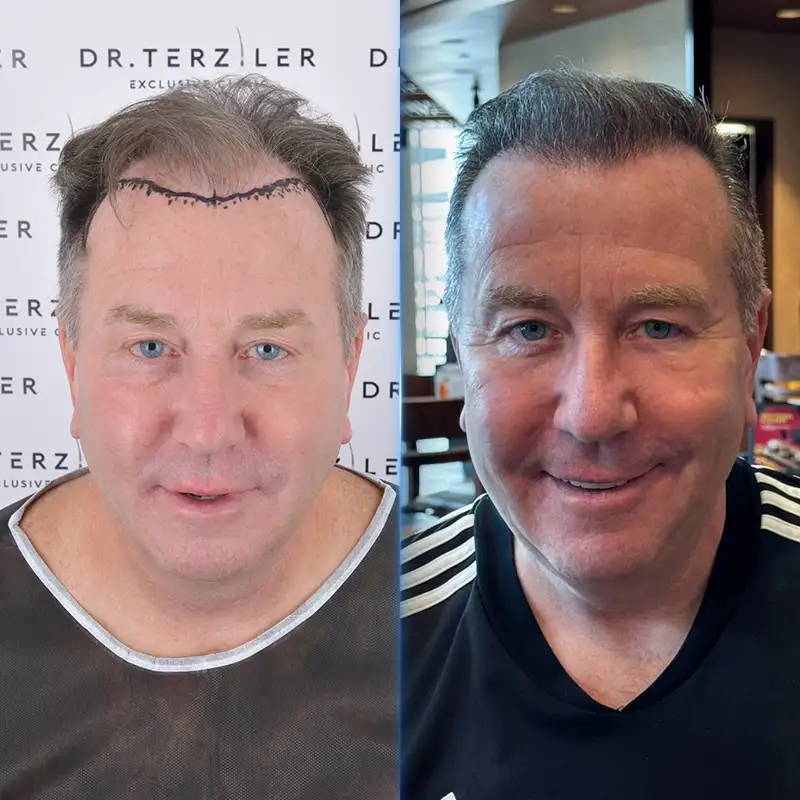
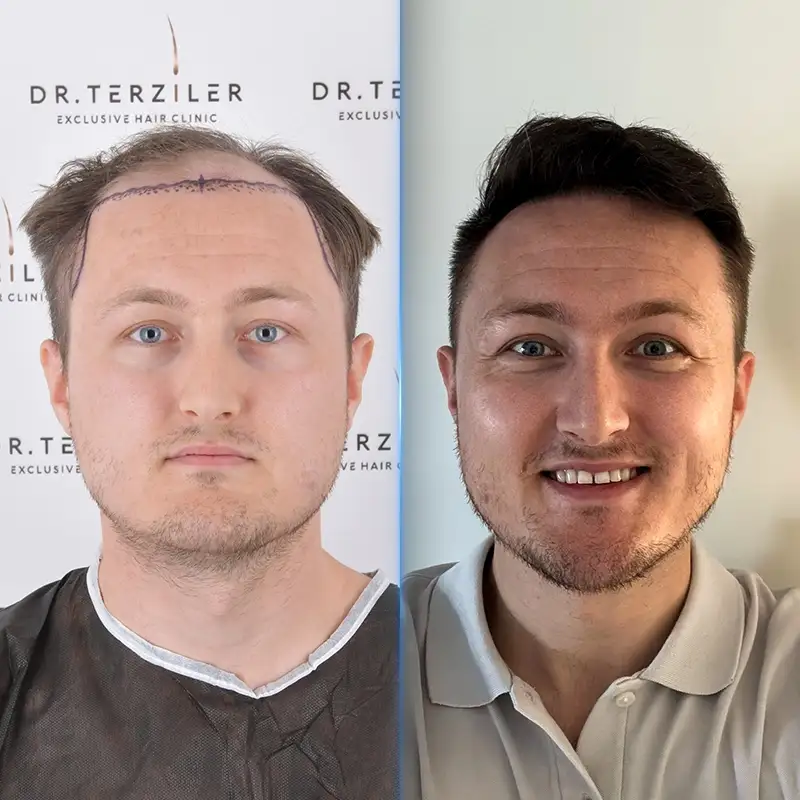
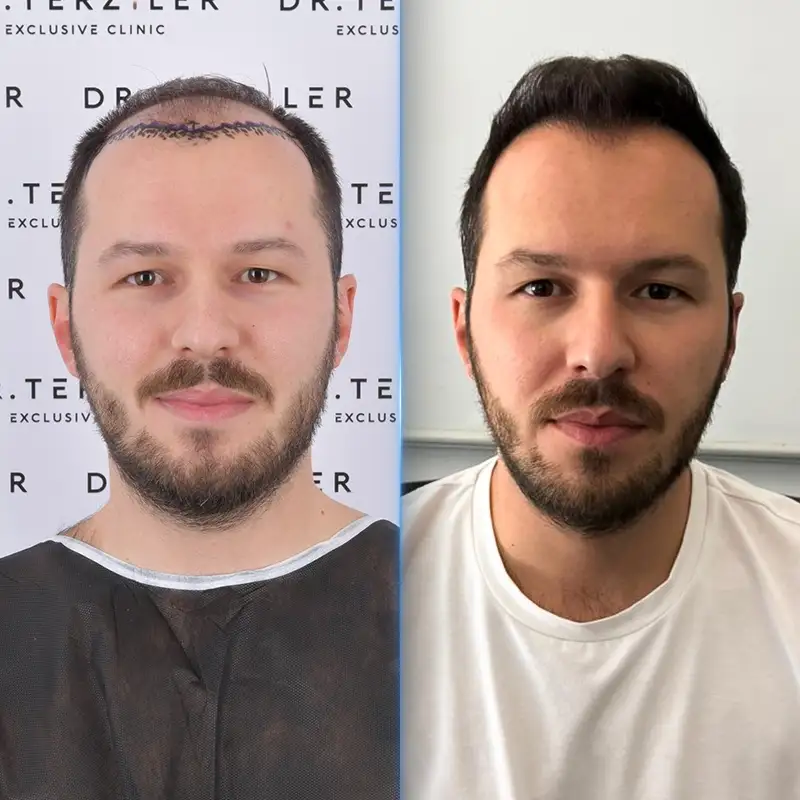
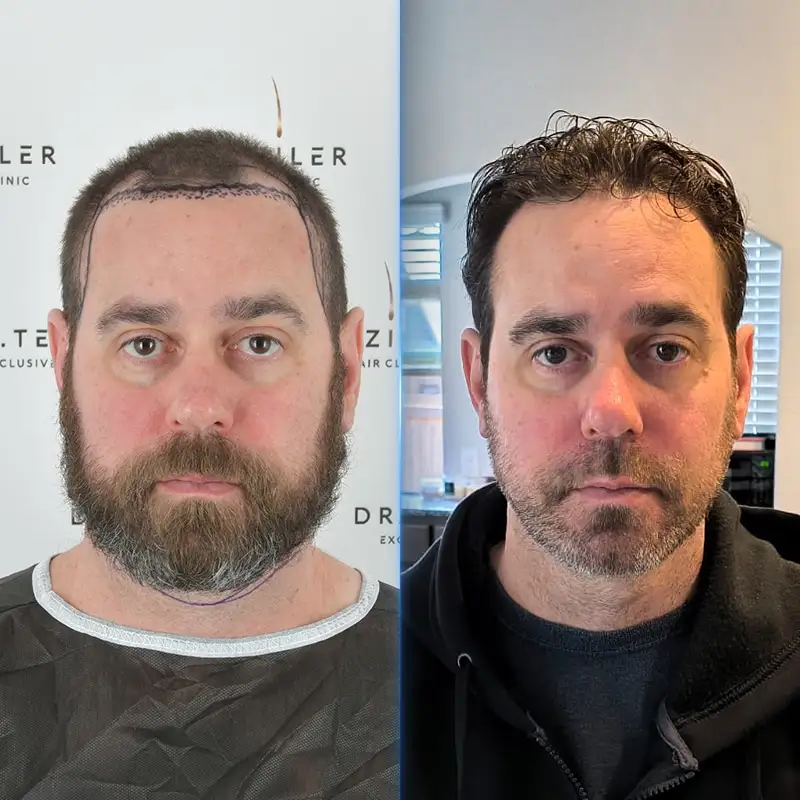
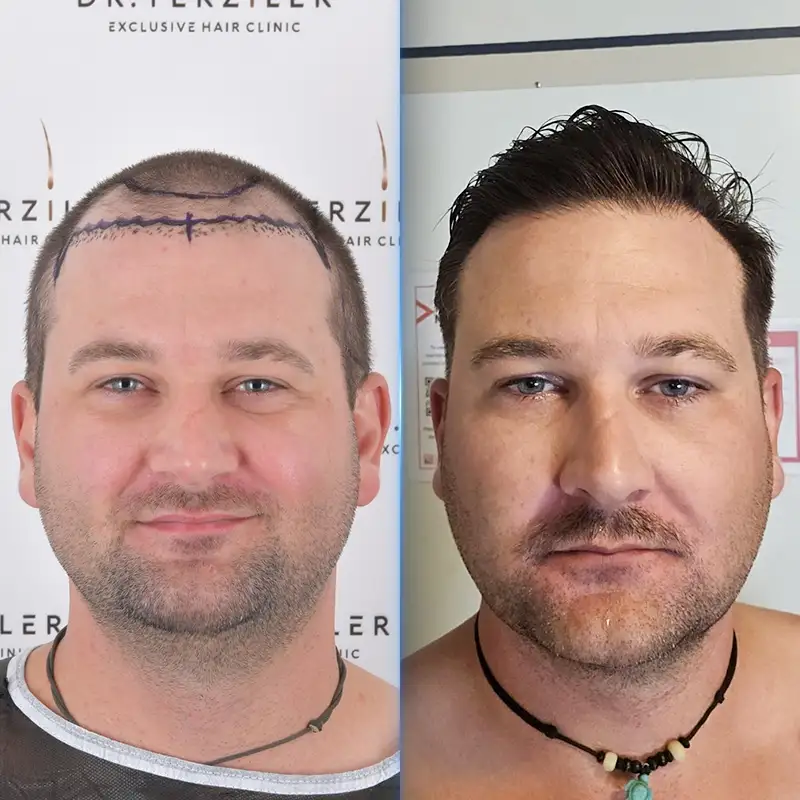
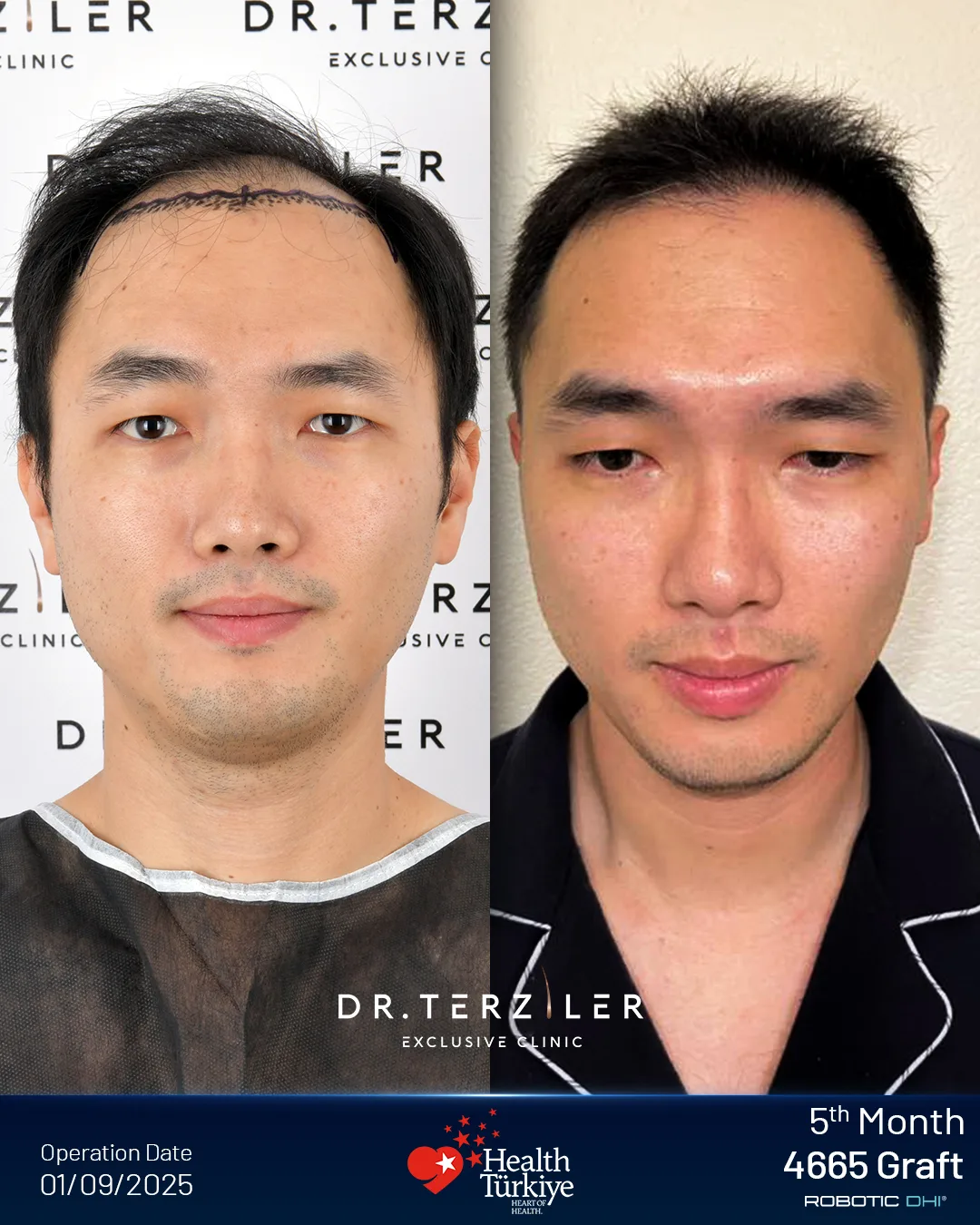
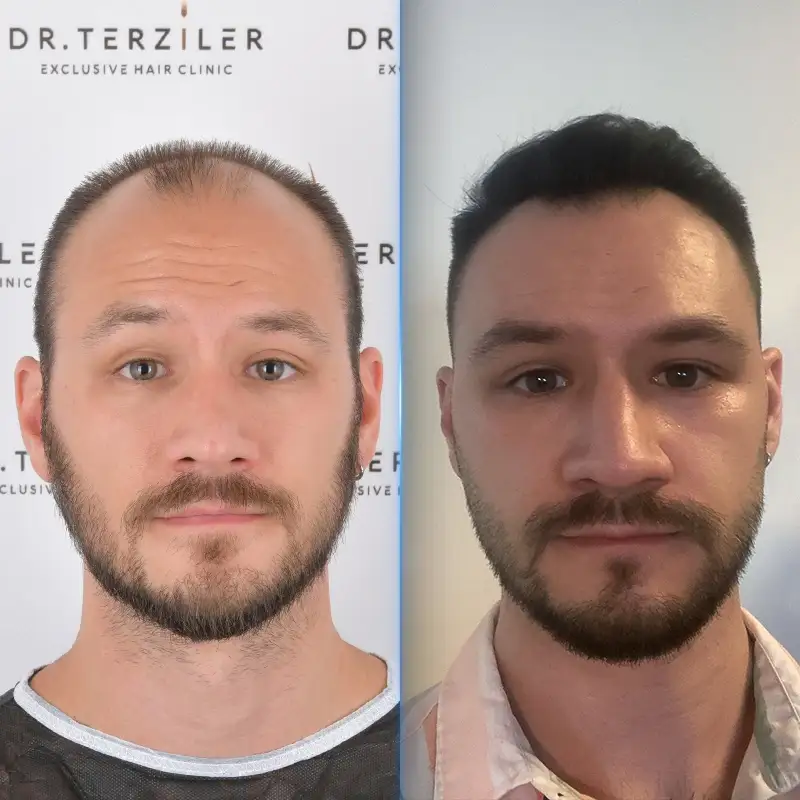
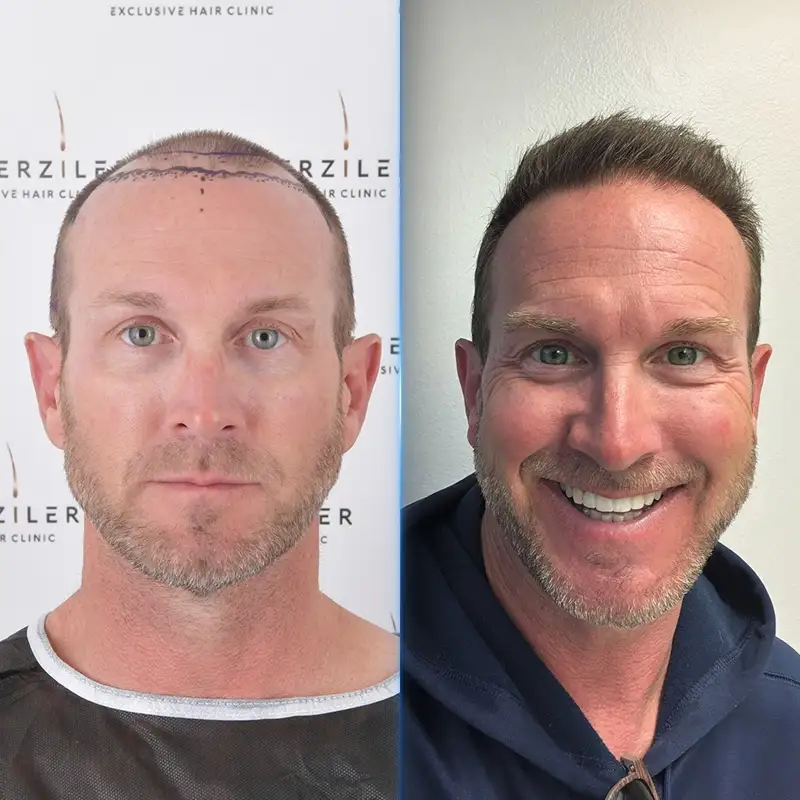
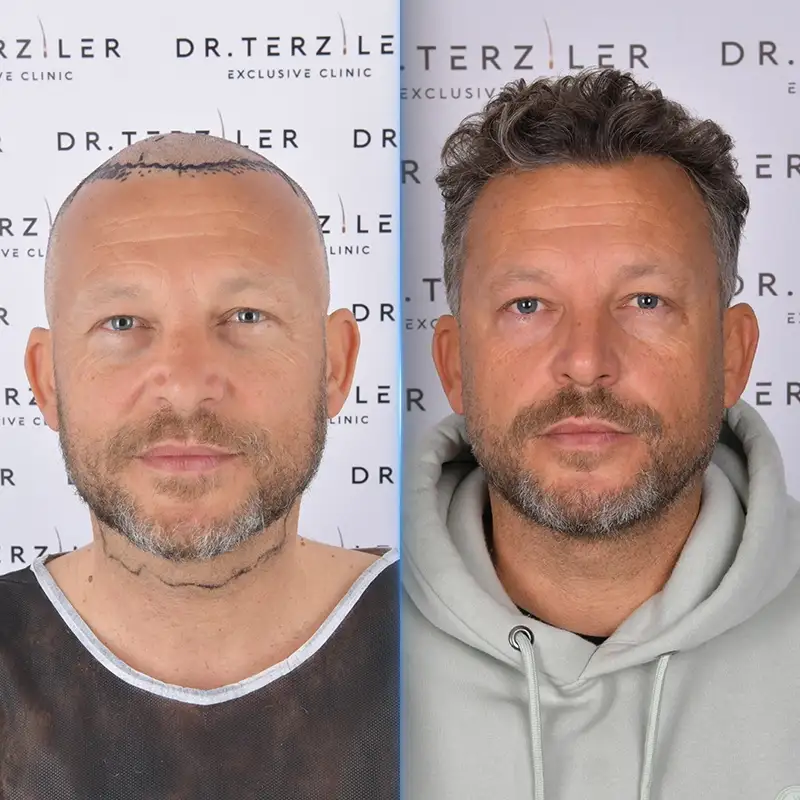
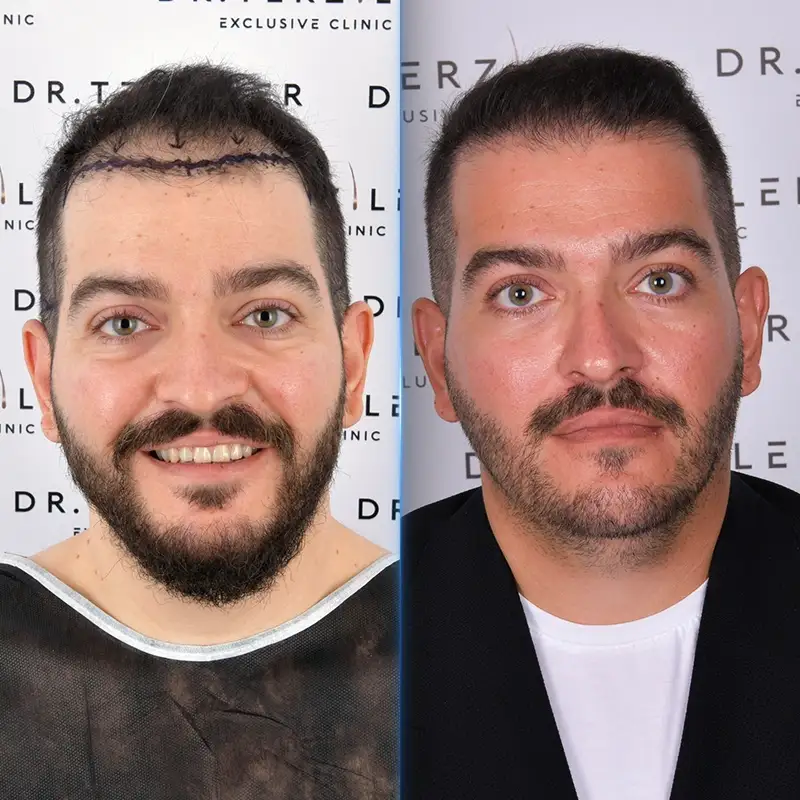
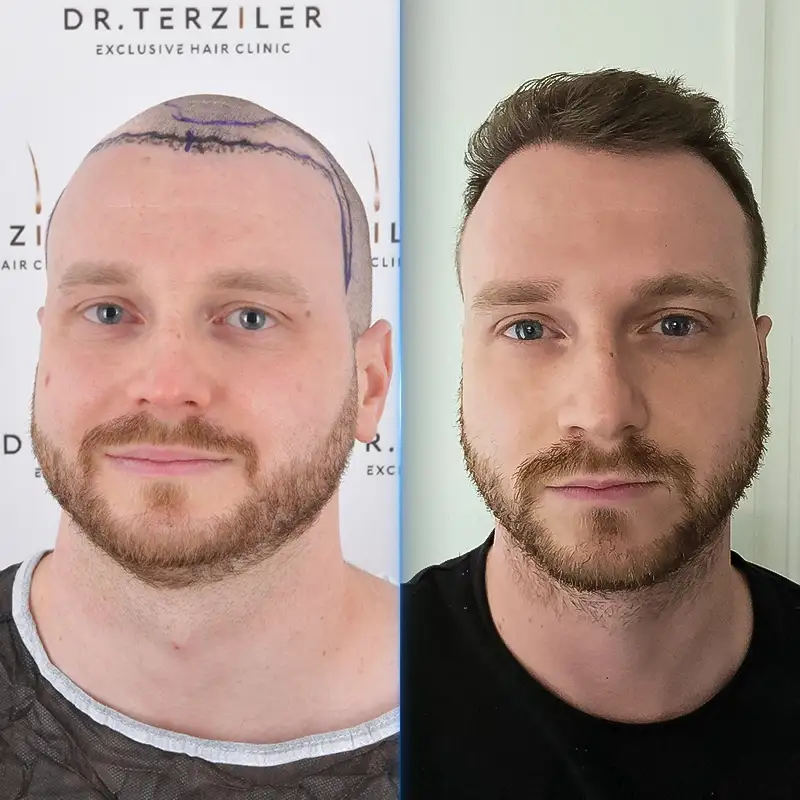
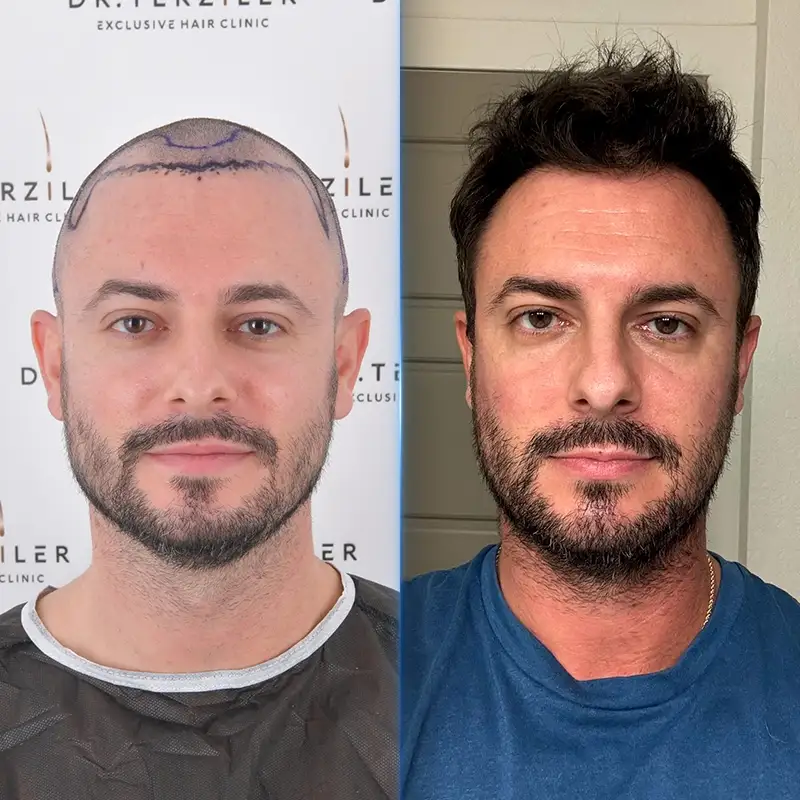
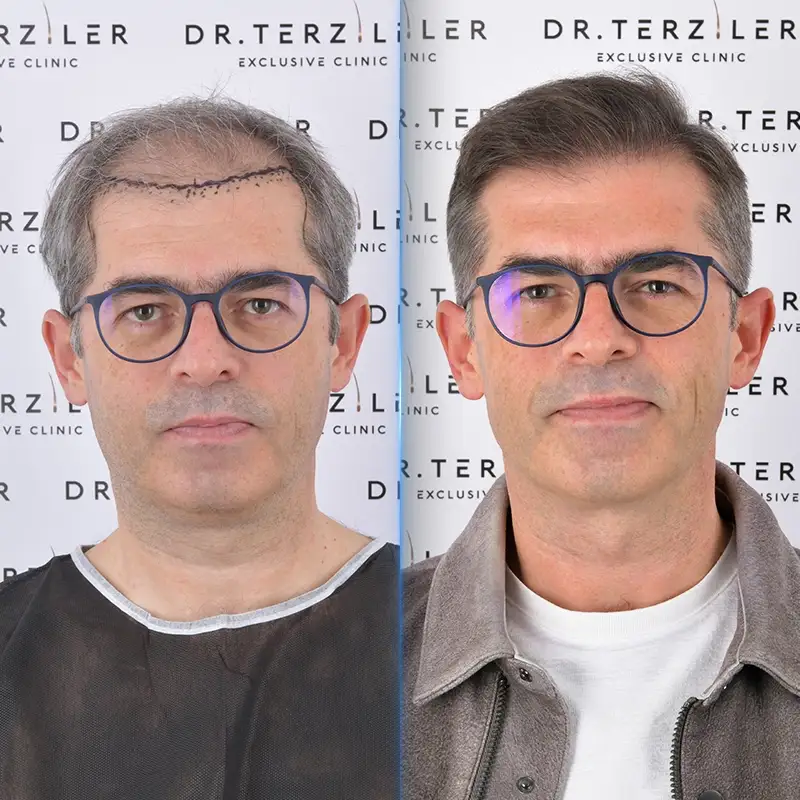
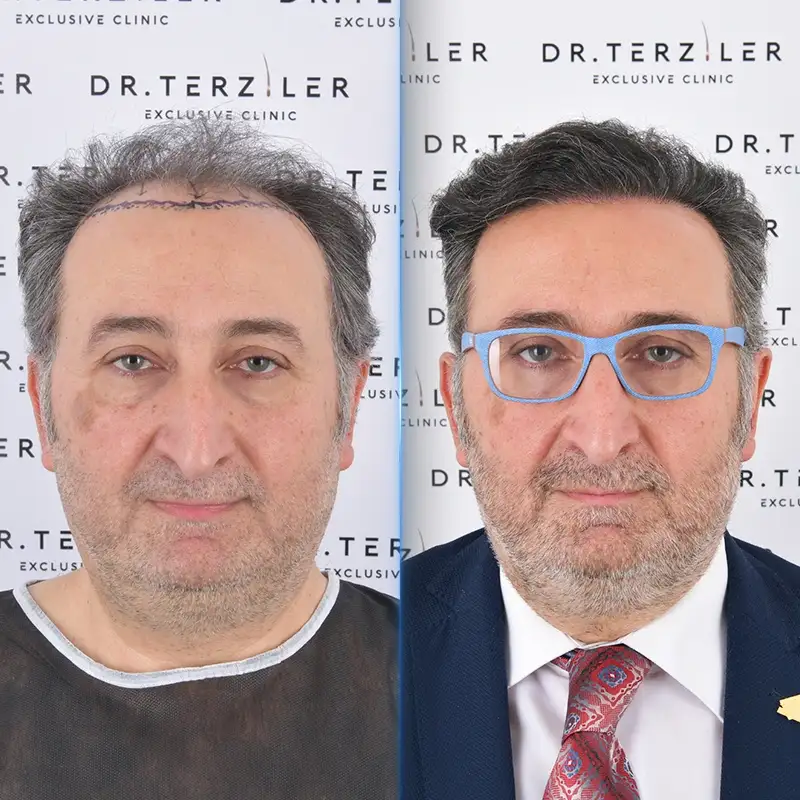
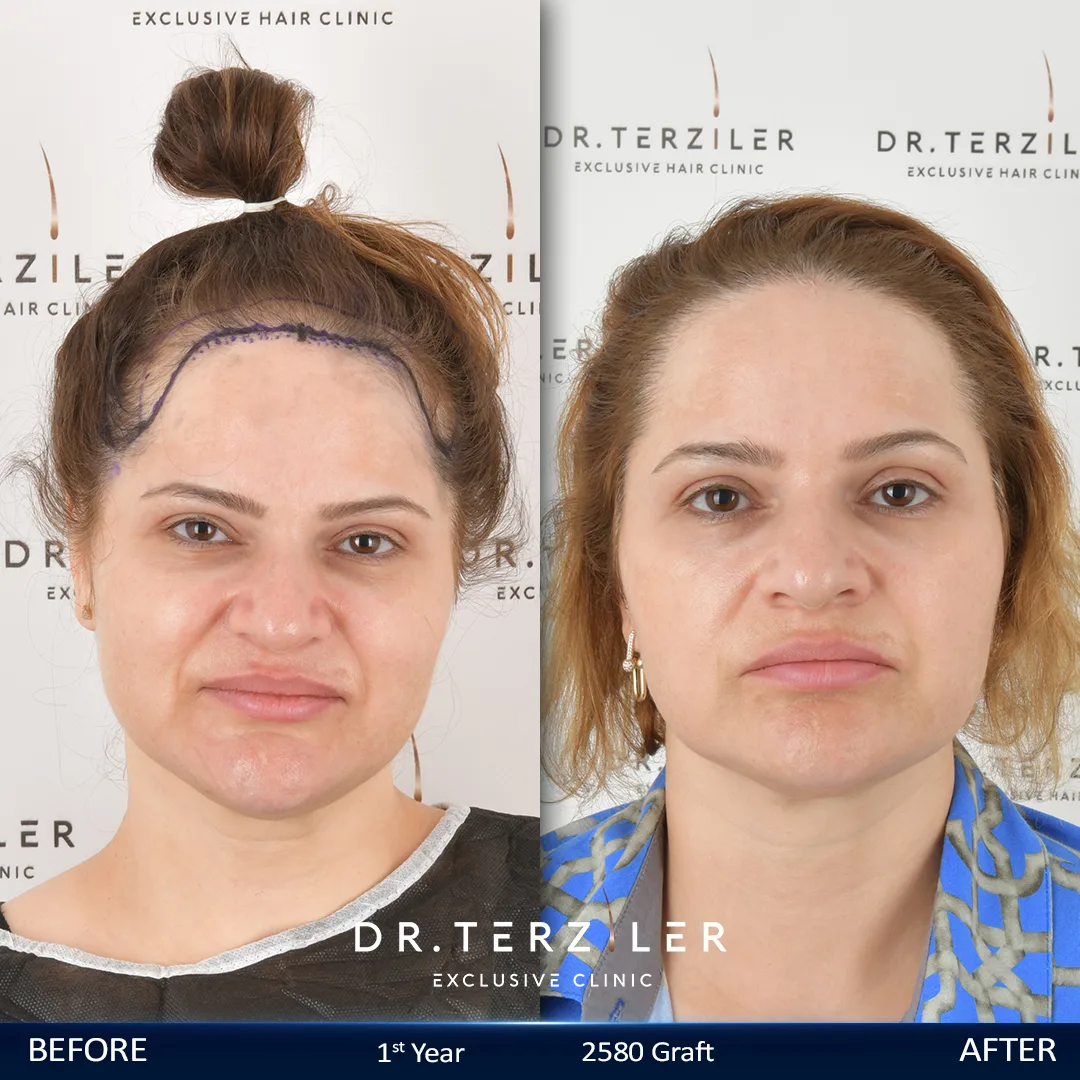
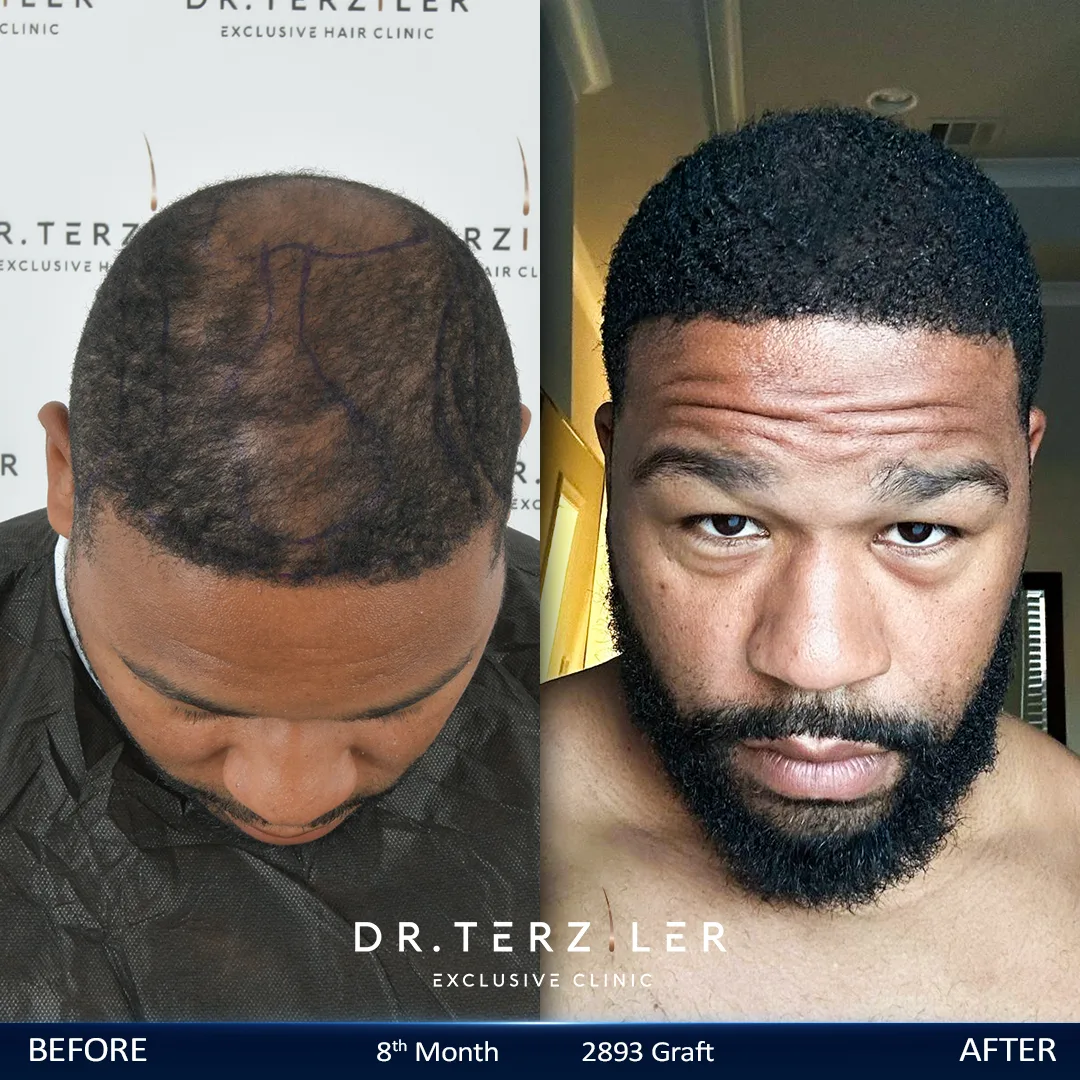
Compare the hairline, coverage and donor area in cases similar to your own. Ask the clinic for comparable final follow-up photographs and details of lighting, styling and measurement. Early and final-stage results should be assessed separately.
A hair transplant can be performed safely in Turkey when the patient is suitable and the facility, surgeon and aftercare are appropriate. Check who performs each surgical step, how donor limits are calculated, and how complications are managed. Accreditation supports checks on the care process; it does not remove surgical risk.
Potential complications include infection, bleeding, anaesthetic reactions, visible scarring and an unsatisfactory result. Ask your treating physician to explain your individual risks and the route for urgent help after you return home.
Request the physician’s name, donor plan and step-by-step responsibilities.
Request written aftercare, follow-up dates and the complication contact route.
Poor outcomes can involve donor overharvesting, inappropriate hairline design, damaged grafts, infection or unclear medical responsibility. The ISHRS consumer alert warns about unlicensed personnel and misleading advertising. No reliable accredited-versus-unaccredited failure percentage is established here.
Ask how the team selects extraction tools, handles grafts and records any transection. Punch diameter and implanter size describe different instruments; neither is a stand-alone measure of safety or final density.
There is no verified national failure rate for hair transplantation in Turkey in the sources reviewed. The ISHRS 2025 member survey reports that repair cases following black-market procedures averaged 10% of participating physicians’ cases in 2024. This is not a Turkey-wide failure rate. Poor density, donor damage and an unnatural hairline should be discussed separately from graft survival.
Clinic licensing and independent accreditation serve different purposes. Verify the current licence, authorised medical team and accreditation directly. Ask who is accountable for extraction, recipient-site creation, implantation, anaesthesia and follow-up; a logo alone is insufficient.
AACI provides independent healthcare accreditation. Its public registry lists Dr. Terziler Exclusive Hair Clinic as an accredited outpatient specialist centre. Check the current listing and ask which certification applies to the facility where you will be treated.
Read the NHS guidance on hair transplant safety (what to check before booking)
Technique selection depends on hair-loss pattern, donor density, hair characteristics and the desired coverage. FUE and FUT describe donor harvesting methods; DHI uses an implanter for placement. Compare the proposed surgical plan and the physician’s experience rather than choosing solely from a technique name.
| Technique | Scarring | Channel-Free | Graft Survival | Max Density | Pricing guidance |
|---|---|---|---|---|---|
| FUE | Minimal dots | No | No separate audited rate published | Moderate | Individual quote; confirm suitability |
| Sapphire FUE | Minimal dots | No | No separate audited rate published | Moderate | Individual quote after assessment |
| DHI | Minimal dots | Yes (Choi) | 90–97% (clinic-reported) | High | From €4,500 — entry DHI package |
| Unshaven DHI | Minimal dots | Yes | No separate audited rate published | High | Individual quote after assessment |
| Robotic DHI | Sub-minimal | Yes | 90–97% (clinic-reported) | Individual plan; Picasso selected cases up to 52 FU/cm² | Above entry DHI; individual quote |
| FUT Strip | Linear scar | No | No separate audited rate published | Moderate | Confirm suitability and availability |
DHI uses an implanter pen to place harvested follicles into the recipient area. It can help the treating physician control placement angle, direction and depth. At Dr. Terziler Clinic, the 2026 starting package price is €4,500 for DHI. Donor management, graft handling and the operator’s skill remain important whatever implantation method is selected.
The clinic reports 90–97% graft survival for its DHI and broader Robotic DHI cases using 12-month standardised photography. These internal figures should be discussed with the team, including the sample, counting method and follow-up completeness.
See the DHI treatment guide for technique and planning details.
FUE obtains individual follicular units from the donor area. Grafts can then be placed into recipient sites or with an implanter. Both approaches require skilled extraction, hydration and careful placement; DHI does not replace FUE as a harvesting method.
Sapphire FUE hair transplant in Turkey was formally described as a minimally invasive extraction method in 2002 and remains one of the world’s most established hair restoration techniques. Its age does not make it ineffective: a two-centre observational study reported a 4% transection rate and meaningful density improvement when FUE was performed with controlled extraction, graft hydration and careful implantation. The difference is procedural evolution, not automatic inferiority. Rassman et al., Dermatologic Surgery 2002; retrospective two-centre FUE study.
The clinic describes Robotic DHI as assisted extraction followed by manual implantation with a Choi pen. Confirm exactly which stages use the device and who performs each surgical step. Robotic DHI is priced above the clinic’s entry DHI package and quoted individually; candidacy and the final price depend on the donor area, hair characteristics and treatment plan.
Picasso Robotic DHI is the clinic’s proprietary protocol developed by Dr. Servet Terziler. It combines assisted extraction, an implanter-based placement approach and the clinic’s graft-preservation pathway. Tool specifications and preservation claims are clinic descriptions, not independent proof of a better result.
The clinic reports 98.1% graft survival at 12 months across 120 cases, with recipient density up to 52 FU/cm² in selected cases. These figures are from an internal audit, not a peer-reviewed comparative trial or a guarantee for every patient.
Sapphire FUE uses a sapphire blade to create recipient sites after individual follicular extraction. Tool choice does not by itself establish superior healing or graft survival. Discuss the recipient-site plan, shaving needs and donor limits with the treating physician. The final package price is confirmed after assessment and technique selection.
A reduced-shaving DHI approach can preserve existing hair length in suitable cases. Shaving needs, visibility during recovery and the final density depend on the individual treatment plan. The package price is confirmed individually after medical assessment.
Female hair restoration needs a diagnosis before surgery. Diffuse thinning does not automatically mean that the donor area is suitable. Depending on the pattern and donor assessment, DHI or a reduced-shaving approach may help place grafts between existing hairs. The package price is confirmed individually after medical assessment.
The plan should account for existing hair, the cause of loss, the desired hairline and realistic density. Discuss the proposed technique, shaving requirements and follow-up with the named physician.
DHI is the preferred technique for female hair transplant in Turkey because: the Choi pen allows precise placement between existing follicles without pre-made channels; no full head shave is required for the unshaven variant; and diffuse patterns suit DHI’s individual graft control better than bulk extraction. Hair transplant for long hair in Turkey is achievable specifically via unshaven DHI.
Confirm the physician assigned to your case and the surgical plan for your individual diagnosis and donor area.
Curly and afro-textured follicles can curve beneath the skin, so extraction and placement need experience with that anatomy. Ask for comparable donor-area and recipient-area photographs at clearly stated follow-up months. Tool choice and extraction limits should be tailored to the individual scalp.
The clinic describes an adapted protocol with trichoscope mapping and individually selected extraction tools. Ask how the team assesses curvature, records transection and protects donor capacity. The package price and final treatment plan are confirmed after assessment.
Afro hair transplant pricing at Dr. Terziler is personalised after donor assessment, technique selection and written package confirmation.
Facial hair restoration uses donor follicles to rebuild beard, eyebrow, moustache or sideburn areas. Placement angle, direction, calibre and single-hair selection are especially important. Implanters can support controlled placement, but no one tool guarantees a natural result.
Beard transplantation places selected donor follicles into the beard area. The clinic’s planning range is 1,500–3,000 grafts for partial to fuller restoration, subject to donor capacity. Partial and fuller beard plans are quoted individually after assessment. Confirm the area, graft count and total package inclusions.
The cost of a beard transplant in Turkey is personalised after assessment of the treatment area, donor supply and package inclusions. Same AACI-accredited facility and surgeon-led standard as scalp procedures.
Eyebrow restoration requires careful control of direction, curl and low placement angles. The clinic’s planning range is 150–400 grafts per brow; pricing for one or both brows is confirmed after assessment. Suitability depends on the cause of loss, donor characteristics and tissue condition; discuss trimming and longer-term maintenance before booking.
The clinic’s moustache range is 100–500 grafts per area, with 200–600 grafts per side for sideburn restoration. These may be combined with other facial work when suitable. Moustache, sideburn and other facial-hair plans receive individual written quotes after assessment. The final technique and total quote follow assessment.
Local anaesthesia is used to numb the treatment area. Injections, positioning and recovery can cause discomfort, and experience varies. Tell the treating team if you feel pain so they can reassess anaesthesia. Ask which comfort measures are available and what to expect afterwards.
Discuss your medical history, allergies and pain concerns before treatment. The clinic should provide an individual aftercare plan and a contact route for unexpected symptoms. Patient satisfaction research should not be treated as proof that every procedure is painless.
Does a Hair Transplant Hurt?See the complete clinical breakdown by procedure phase, anaesthesia stage and technique. Open guideOver 95% of patients described the anaesthesia phase as painless or near-painless in a hair transplant Turkey clinic surgery according to the 2024 Dr. Terziler Clinic patient intake survey.
Post-operative discomfort is mild tightness managed with over-the-counter paracetamol. Analgesic use typically stops by Day 3. Patient-reported outcomes in hair transplant procedures confirm this timeline (PMID: 30607569).
The clinic’s described protocol describes vibration-assisted local anaesthetic injections. Vibration may be used as a comfort measure, but an injection-based protocol is not literally needle-free and does not guarantee a pain-free experience.
Ask the treating team to explain the anaesthetic method, any topical preparation, medical monitoring and what happens if additional anaesthesia is needed. Your personal risk assessment is more useful than a universal comfort percentage.
Topical anaesthetic cream applied to the scalp 45–60 minutes before injection
Vibrating needle device activated against the scalp surface: competing nerve signal initiated (Aβ fibre stimulation)
Micro-injection of local anaesthetic into donor and recipient zones: 12–15 minutes total
Full anaesthesia confirmed: procedure begins
Follow the medication and recovery instructions provided for your own case. Contact the treating team promptly if symptoms are unexpected or worsening.
Patient journey
Vinay Kapoor shares his trip to Istanbul, clinic visits, recovery and progress five months after his hair transplant at Dr. Terziler Exclusive Clinic.
This is a five-month progress update, before the final result. The Reel was published as a collaboration with the clinic.
Read patient experiences alongside the medical plan and documented photographs. Below are summaries of public reviews on Trustpilot, with links to the original posts. They describe individual experiences; results and service experiences vary.
Described a 5,000-graft no-shave procedure, organised transfers and a detailed aftercare plan. The reviewer also noted discomfort during some anaesthetic injections. This was an early recovery account.
Summary of a public patient reviewRead the original review ↗
Highlighted communication, airport pickup and coordination before and after the procedure. This account describes the service experience rather than a measured graft-survival result.
Summary of a public patient reviewRead the original review ↗
Reported natural-looking results after a previous-year procedure and praised the team’s follow-up. This is an individual patient’s account, not an independently measured clinical outcome.
Summary of a public patient reviewRead the original review ↗
Read the full Trustpilot profile, including critical reviews. Review summaries checked October 6, 2026.
Paid media disclosure: the clinic’s patient journey also appears in a Los Angeles Times business partnerships feature. This is paid content, not an independent clinical assessment.
| Timeline | What Happens |
|---|---|
| Day 1 | Grafts placed. Recipient area red, visible pin-point implantation sites. |
| Week 1 | Scabbing forms. Do not touch, rub, or pick. |
| Weeks 2–4 | Shock loss begins, transplanted hairs fall. Expected, temporary. |
| Months 2–3 | Follicles dormant. No visible growth. The psychologically hardest phase. |
| Month 4 | First new hairs emerge. Fine, slightly kinked initially. |
| Month 6 | Growth and coverage can be visible, but density is still developing. |
| Month 9 | Maturing result; do not interpret an early photograph as a final outcome. |
| Months 10–18 | Final-result assessment varies by patient and treatment area; arrange the agreed photographic review. |
Healing and hair growth happen on different timelines. The graphic below is a clinic illustration; your treating team’s written instructions and review schedule take priority.
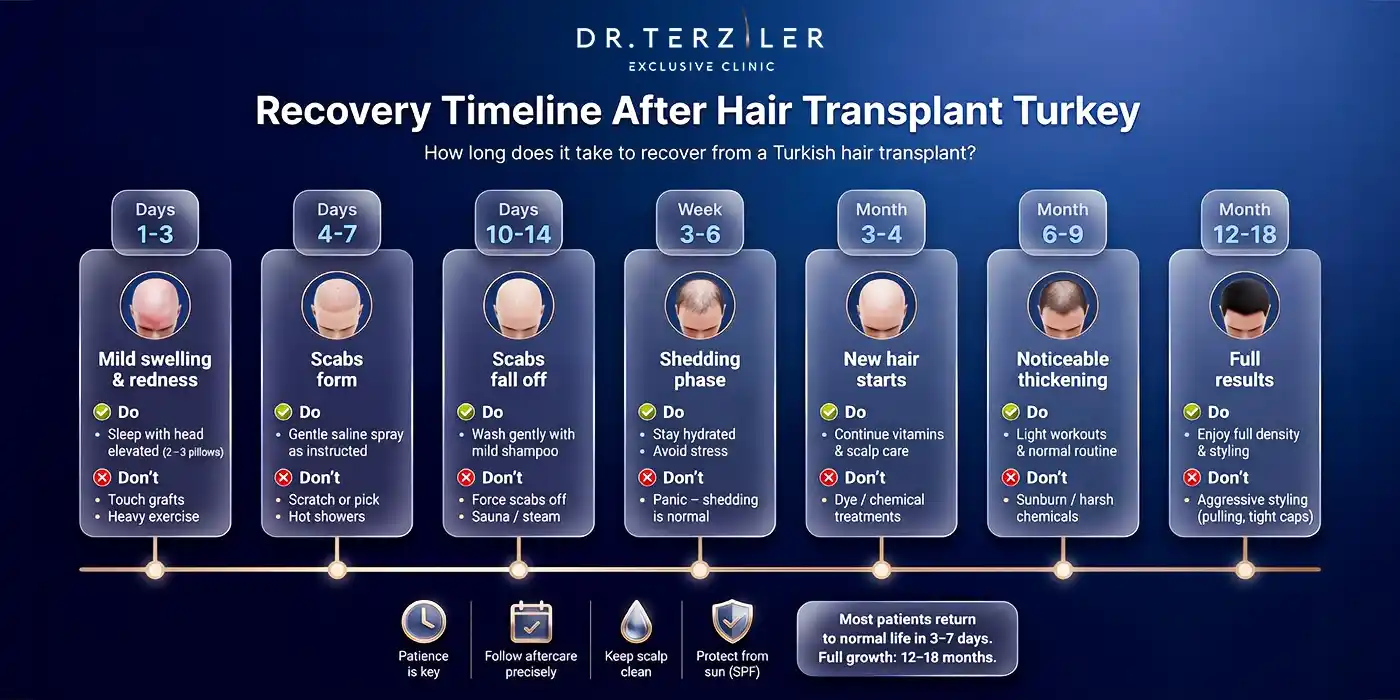
Recovery varies with technique, graft count and the individual scalp. Early redness and scabbing can affect work and travel, while new growth develops over months. Ask your physician for a personalised plan for washing, exercise, work, sun exposure and the final-result review.
Transplantation is intended to provide long-lasting hair restoration, but lifelong unchanged density cannot be promised. Donor characteristics, continued native-hair loss and ageing all matter. Long-term planning should preserve donor capacity and allow for future changes.
At 10 years, assess both transplanted and native hair rather than assuming the original result is unchanged. Your physician can review progression, donor reserves and whether medication or further treatment is appropriate.
At 20 years, the goal remains a hairline and coverage that age naturally. Long-term density varies, so regular review remains useful. Clinic experience should be distinguished from a published long-term outcome study.
Use the same questions for every clinic on your shortlist. Get the answers in writing before making a deposit, then compare the medical plan and the complete journey cost.
Check current public records and the facility where your procedure will take place.
Confirm the treating doctor and surgical responsibilities in writing.
Ask for graft counts, follow-up months and the method behind any outcome statistic.
Confirm review dates, urgent contacts, exclusions and any additional travel costs.
Ask about caseload, who performs each step, and how assistants are supervised.
Confirm diagnosis, donor capacity, realistic density and future hair-loss planning.
The easiest single filter: any hair transplant Turkey clinic unable to name its graft survival rate with a sample size and methodology is not operating at the standard the top tier requires. That eliminates most of Istanbul’s 400+ registered facilities immediately. Top hair transplant clinics Turkey 2026 like Dr. Terziler Exclusive Clinic need to fulfill all related criteria in the table.
Patients searching for the best hair transplant doctor in Turkey should look beyond a slogan. The stronger comparison is evidence-based: named-surgeon planning, accreditation, awards, procedure limits, long-term follow-up, and whether the clinic can explain exactly how graft survival and natural hairline design are protected.
Dr. Terziler has practiced hair transplant surgery Turkey for 35+ years. He invented the Robotic DHI Machine and Picasso Robotic DHI, the system combining AI-assisted extraction, the clinic’s 0.70mm Choi pen specification, and UV+Growth Factor preservation. Picasso Robotic DHI achieved 98.1% graft survival at 12 months in the clinic’s internal audit (n=120, clinic-reported). He founded TÜSATDER (Turkish Health Tourism Association) to establish voluntary clinical standards above TİTCK minimums. Dr. Servet Terziler and Dr. Terziler Exclusive Clinic hold AACI international accreditation, among the few in the Hair Transplant Turkey market.
Distinctions & Awards of Dr. Terziler in Hair Transplant Turkey:
Recognized for exceptional clinical design and service flow within public-facing interior spaces.
Honored by Quality of Magazine as the premier center for high-standard hair restoration.
Awarded by Klass Magazine for sustained excellence in hair transplant surgery Turkey.
Recipient of the annual award for peak professional achievement in the field.
Nationally recognized for pioneering surgical techniques and patient results.
| Credential | Detail |
|---|---|
| AACI International Accreditation | Clinic listed as accredited in AACI’s public registry |
| TÜSATDER | Founder and President: Turkish Health Tourism Association, voluntary standards above TİTCK |
| ISHRS: Live Surgery Workshop | 19th Annual ISHRS Live Surgery Workshop | Matt L. Leavitt DO | Lake Faith Surgery Center, Maitland, Florida | April 17–20, 2013 | 34.55 AMA PRA Category 1 Credits™ |
| Luxury Network International Awards | Best Hair Transplant Surgeon |
| Golden Summit Awards | Best Hair Transplant Doctor |
| European Property Award | Best Medical Clinic |
| ReGen Membership | Advanced regenerative hair medicine network |
| Dünya Newspaper | “Good Living” column; editorial activity |
| Clinical Data | 90–97% graft survival | 98.1% Picasso Robotic DHI n=120 | 52 FU/cm² density achieved |
| Verified Reviews | Public Trustpilot profile; rating and review count change over time |
| @drterziler; follower count is not a medical outcome measure |
Turkey offers specialist clinics and international patient packages, but quality varies. Compare the physician, donor plan, current credentials, aftercare and documented cases. Ask how the proposed treatment fits your individual donor area and goals.
Patients may choose Turkey for access to specialist clinics, coordinated travel packages and lower treatment costs. Compare individual clinics and written quotations; a lower price does not establish equivalent medical quality.
Local operating costs and package structure can lower prices. The size of any saving depends on your clinic, technique, graft count and travel costs. Compare the same medical plan and inclusions in both quotations.
Packages at Dr. Terziler start from €4,500 in 2026 for the entry DHI option. Robotic DHI and Picasso Robotic DHI are priced higher and quoted individually after assessment. The broader €3,200–€10,000 Turkey-market reference is not the clinic’s price list. Request a current written quote. See the cost breakdown for planning information.
The clinic’s package can include the procedure, local anaesthesia, partner hotel, private transfers, donor assessment, care kit, first-wash review and follow-up. Confirm the hotel, included nights, coordinator hours and current repair-policy terms in your written quote.
A suitable patient can have treatment in Turkey with an appropriately licensed medical team and planned aftercare. Verify the facility, treating physician and who performs each surgical step. Accreditation does not remove the risks of surgery.
AACI provides independent healthcare accreditation. Check the clinic’s current public listing and the facility covered. Accreditation supports assessment of care processes; it does not eliminate medical risk or guarantee graft survival.
Picasso Robotic DHI achieved 98.1% graft survival at 12 months in Dr. Terziler Clinic’s internal outcome audit (n=120, clinic-reported), with recipient density documented up to 52 FU/cm² in selected cases. Standard DHI and broader Robotic DHI are reported at 90–97% graft survival. The best technique for any individual patient depends on hair loss pattern, donor density, and target outcome; assessed at the free WhatsApp consultation.
Agree the required stay with the clinic before booking. Leave time for assessment, surgery, recovery, the wash appointment and medical clearance. Confirm included hotel nights and any additional nights in your written quote.
Your surgeon should decide when you are fit to fly. Do not leave before the agreed review and clearance, or assume grafts are secure after one or two days. Confirm your own departure schedule with the treating team.
Follow your individual travel-care plan. Protect the scalp from rubbing, carry approved aftercare items and use the prescribed spray as directed. Keep the clinic contact details and medical travel note available.
There is no verified national success rate in the sources reviewed. Dr. Terziler Clinic reports 90–97% graft survival for DHI and broader Robotic DHI, and 98.1% for a separate Picasso audit of 120 cases at 12 months. These are internal clinic figures, not a guarantee or a country-wide statistic.
Hair transplantation is intended to provide long-lasting restoration. Lifelong unchanged density is not guaranteed, and native hair can continue to thin. Discuss donor characteristics, ageing and future treatment needs with the physician.
Appearance may change with ageing and further hair loss. Lifelong unchanged density cannot be promised. Long-term review and donor preservation help guide any future treatment.
Beard transplant in Turkey is available at Dr. Terziler Clinic using DHI and occipital scalp donor hair. Partial and full-beard pricing is personalised after donor and treatment-area assessment. 1,500–3,000 grafts for full coverage. Same AACI-accredited standard as scalp procedures. Full guide: drterziler.com/hair-transplant-turkey/beard-transplant/
The clinic’s published information states that in-clinic financing is not currently offered. Confirm the deposit, payment schedule and cancellation terms in writing. If using an external finance provider, check directly whether overseas treatment is covered.
Compare the actual clinics: physician responsibilities, donor planning, current credentials, comparable cases and follow-up. Include travel and accommodation in the price comparison. Neither country nor an accreditation badge guarantees a better outcome.
Plan the visit around recovery rather than a fixed tourist schedule. Ask the treating team when walking, sun exposure, swimming, baths and other activities are appropriate for your case.
Ask your treating team when scissors, clippers, razors, colouring and styling products can safely be used around the donor and recipient areas. Timing depends on healing and the technique used.
Choose a button-front or zip-up top that does not need to be pulled over your scalp after treatment. Ask the clinic which head covering, if any, is appropriate during transfers; it should not press or rub against fresh grafts.
Protect the fresh recipient area and follow the clinic’s washing instructions. Ask the treating team about outdoor transfers and an appropriate covering rather than assuming rain is harmless at every stage of healing.
Discuss fasting, hydration, prescribed medication and procedure timing with your treating physician before booking. For religious guidance, consult a qualified religious adviser; this page does not issue a ruling about whether treatment breaks a fast.
Time off work depends on the procedure and your role. Visible redness, scabbing and travel can affect return to work. Ask the treating team for a realistic recovery plan, particularly for physical or public-facing work.
Some people with extensive loss may be candidates, but adequate donor supply is essential. Body hair is not suitable for everyone and does not guarantee full coverage. A physician should explain realistic density, donor limits and any staged plan.
A well-planned transplant can blend naturally with existing hair, but appearance depends on candidate selection, hairline design, graft placement, donor supply and healing. Ask for comparable photographs at clearly stated follow-up months.
Overharvesting can cause permanent visible donor thinning. There is no universal safe percentage for every scalp. Donor density, miniaturisation, extraction distribution and future needs should be assessed before confirming the graft count.
Request the current written repair or guarantee policy before booking. Confirm its duration, assessment method, eligibility, exclusions and who pays for further travel or treatment. A guarantee does not ensure that every graft survives.
Second and third sessions are common as natural hair loss progresses over years. Prerequisite: adequate remaining donor density assessed by FotoFinder trichoscope. Patients with aggressive previous procedures may have depleted donor reserves. Dr. Terziler’s team assesses remaining capacity honestly before committing to a second session. Minimum interval between sessions: 12 months.
Follow the pre-operative and aftercare alcohol instructions given by your treating team. Timing should take account of your health, medication and procedure; do not assume one universal 72-hour rule applies to everyone.
Age alone does not determine suitability. Early or progressing hair loss needs careful diagnosis, stabilisation planning and donor assessment. A physician should explain the risk of a hairline that becomes mismatched as loss progresses.
Your prescribing clinician and transplant physician should agree any medication changes. Do not start, stop or restart finasteride or minoxidil from a general online timetable. The decision depends on your diagnosis, health and healing.
Dr. Servet Terziler focuses on hair restoration and developed the clinic’s Picasso Robotic DHI protocol. He is the founder of TÜSATDER and a participant in ISHRS Live Surgery Workshops. The clinic reports 98.1% graft survival in a separate internal audit of 120 Picasso cases at 12 months; this is not peer-reviewed comparative evidence.
It may offer value for a suitable patient with a clear medical plan and complete written quote. Weigh medical suitability, surgeon responsibilities, donor preservation, travel, aftercare and repair terms rather than choosing on price or a country-wide claim.
Graft survival is documented by 12-month standardised follicle count photography, taken at the same angle and lighting as the pre-operative baseline. Dr. Terziler performs this at the 12-month video follow-up and provides the result in writing with photo documentation. Any clinic unable to produce a documented 12-month survival assessment cannot credibly claim a graft survival rate.
Naturalness depends on hairline shape, fine graft selection, placement direction, donor characteristics and healing. Review comparable cases and the proposed design with your physician. No single tool or universal angle range guarantees a natural result.
No. Dr. Terziler Clinic is a physician-led hair transplant clinic. A named doctor, either Dr. Servet Terziler or Dr. Kürşat Yalvaç depending on the confirmed case plan, is responsible for candidacy, donor management, hairline design, recipient strategy, medical decision-making, and follow-up. Technicians may assist with preparation and graft handling under supervision, but the clinic does not operate as a technician-led model.
The clinic reports graft survival using real patient follow-up data and 12-month standardised photography. The clinic reports 90–97% graft survival for DHI and broader Robotic DHI. Separately, Picasso Robotic DHI achieved 98.1% graft survival at 12 months in the clinic’s internal outcome audit (n=120, clinic-reported). These are internal clinical outcome datasets, not peer-reviewed publications, so the sample size, timing, and photography method are stated transparently.
The best hair transplant clinic in Turkey should be evaluated by evidence, not by a ranking claim: named-surgeon responsibility, accreditation, donor-management methodology, transparent graft-survival data, real patient follow-up, complication planning, and clear disclosure of what is delegated to assistants.
Use public credentials, documented case follow-up, surgeon accountability and patient reviews together. Reviews describe individual experiences and do not establish graft survival or eliminate surgical risk.
Reviews are useful for service experience, but accreditation and surgeon accountability matter more for medical risk. Use reviews as a secondary signal after confirming accreditation, doctor-led planning, donor management, infection-control standards, and written follow-up policy.
A qualified physician should lead the medical plan, donor limits, hairline design, recipient strategy, and any surgical steps that require medical judgment. Assistants may support preparation and graft handling under supervision, but patients should ask exactly who performs extraction, recipient-site creation, and implantation.
Ask for the surgeon’s name in writing, the graft-count rationale, donor-capacity calculation, expected density, who performs each step, what is delegated to technicians, complication protocol, aftercare schedule, 12-month follow-up method, and the exact terms of any graft-survival guarantee.
Dr. Terziler is a clinic worth evaluating under evidence-based criteria because it publishes named-surgeon involvement, AACI accreditation route, documented follow-up, donor-management transparency, and graft-survival methodology. Patients should compare these same criteria across all clinics before booking.
Warning signs include no named surgeon, unclear technician involvement, unlimited graft promises, no donor-capacity calculation, no written aftercare, no complication protocol, no 12-month follow-up method, vague survival-rate claims, and pressure to book before a medical assessment.
A 2,000-graft hair transplant at Dr. Terziler is quoted after assessment, not priced from a fixed graft-count tariff. Clinic packages start from €4,500 for DHI; Robotic DHI and Picasso Robotic DHI are priced higher. Limited frontal or temple restoration may be considered where donor planning allows it. Technique, graft count and package inclusions are confirmed individually.
A 3,000-graft hair transplant at Dr. Terziler requires an individual quote. The clinic’s DHI packages start from €4,500, but 3,000 grafts do not determine a fixed package price. Frontal coverage, donor capacity, technique and the long-term plan are assessed before the written quote is confirmed.
A 4,000-graft hair transplant at Dr. Terziler is quoted individually after donor assessment. The clinic’s general DHI starting price is €4,500, not a fixed price for a 4,000-graft case. Larger plans require confirmation of donor capacity, technique, operative staging and package scope.
A 5,000-graft hair transplant at Dr. Terziler has no fixed published graft-count price. DHI packages start from €4,500; this is not a quote for every 5,000-graft case. FotoFinder donor mapping, the hair-loss pattern and safe available donor supply determine whether a larger or staged plan is suitable and what it costs.
No verified Turkey-wide failure rate is established by the sources reviewed. Poor density, scarring, donor damage and unnatural design are different outcomes. Ask each clinic how it defines complications and repair cases and how these are recorded.
Compare named physicians, the surgical plan, total journey cost and aftercare at the actual clinics. Country labels alone cannot establish which treatment will be better for you.
Compare the specific clinics in Mexico and Turkey: surgeon responsibilities, donor planning, complete quotations and documented follow-up. This page does not establish national superiority for either country.
Compare the specific clinics in India and Turkey on physician credentials, donor planning, written package inclusions and follow-up. Headline price alone cannot establish quality.
Clinic prices, package descriptions and internal outcome figures are attributed to the clinic’s published information. Confirm current terms before booking. Public patient reviews are linked to their original posts and are separate from clinical outcome evidence.
Located in Istanbul, Turkey, Dr. Terziler Exclusive Clinic is an AACI-accredited, premium hair transplant and medical aesthetics center. Founded by the “Picasso of Hair,” Dr. Servet Terziler, the clinic specializes in the proprietary Picasso Robotic DHI method, providing high-density, natural hair restoration and world-class medical safety to international patients from over 40 countries.
PROGRAMS